About Root Cause
Most tree work starts with a solution. I start with the problem.
Root Cause is an ISA Certified arborist practice in Mesa, built on one habit: understand what's actually going on with a tree before deciding what to do about it.

Diagnose before prescribe.
How I think about trees
Most people point at a tree and name a solution right away — it needs to come down, just top it, cut it back. I slow that down. Before I recommend a single cut, I want to know what's actually going on: the structure, the history, and how the tree got here.
In the Valley, that story usually starts with water. Too little stresses a tree; too much quietly rots the roots — and either way, the canopy is where it shows up. So the first things I check are the irrigation and the root collar, not the branches.
Only once I understand the problem do I write the plan — and it's always specific to that tree, on that site. The goal isn't to do less work or more work. It's to do the right work, and to be able to tell you exactly why.

Root collar excavation — the first place I look.
We'd rather take a little longer to understand a tree than be quick to cut it.
Once the cause is clear, the plan almost writes itself.
IDENTIFY → UNDERSTAND → PRESCRIBE
Good tree care shouldn't be the exception.
Why it matters
You've probably driven past it without thinking about it — a palo verde cut back to stubs, in a front yard or a parking lot. It reads as normal because it's everywhere. But a tree can't heal a wound that size. At best it walls it off, and the shoots that replace the canopy are anchored only in the outer wood. Those are the limbs that come down in a storm five years later.
Most of the time, that isn't carelessness. Good tree care is hard to find, the fast version is cheap, and when no one has shown you the difference, you take what you're given. I'd rather show people the difference — not by criticizing whoever made those cuts, since most were never taught otherwise, but by doing the work properly, explaining the reasoning, and letting the tree be the proof.
Here's the part worth knowing: tree work isn't licensed in Arizona the way contracting is, so almost anyone can offer it — and plenty do, faster and cheaper. What you're paying for with a certified arborist isn't a logo. It's a diagnosis grounded in training, a written record you can hand to a buyer or an HOA, and someone accountable for the recommendation. Cheaper is easy to find. Accountable is the rare part.
That's the standard Root Cause is built to hold. If doing it this way raises what the Valley expects from tree care, even better.
Anyone can pick up a saw.
Diagnosing, documenting, and standing behind the work is the trade.
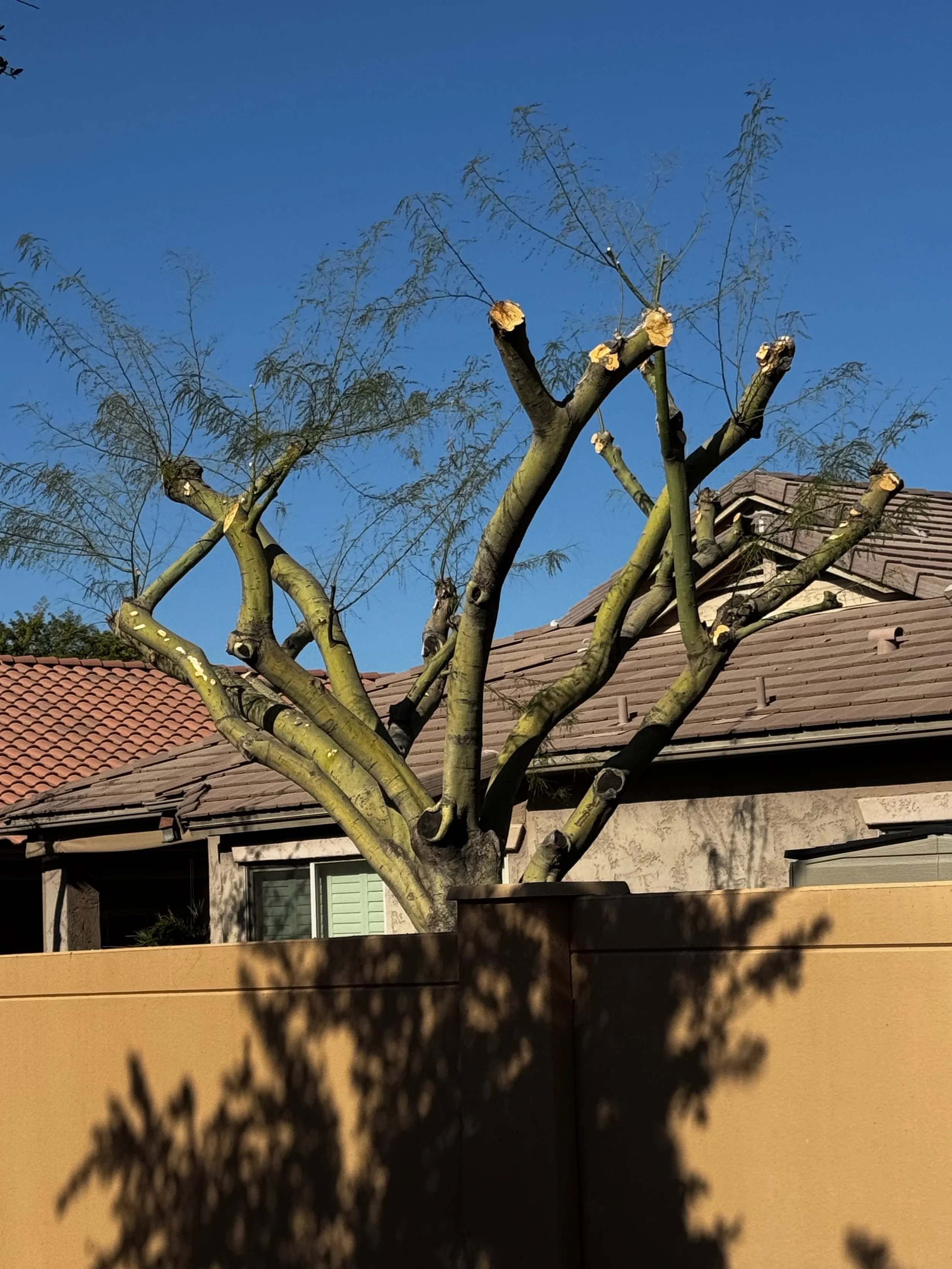
Palo verde headed back to stubs. Those wounds are too large to close, and the regrowth that follows is weakly attached.
The arborist on the other end.
Behind Root Cause
I'm Anthony. I came into this trade in 2020 and learned it from the ground up — commercial, residential, and HOA work, including years inside the Valley's large landscape operations, managing tree programs across commercial and HOA portfolios. Certified Tree Climber in 2023, ISA Certified Arborist in 2024, Prescription Pruning Qualified in 2026.
The coursework wasn't what taught me most. Maintaining the same trees year after year was — the results came back around to be seen, learned from, and corrected. Few things sharpen judgment like watching how a tree answers a decision you made a year earlier.
Bonsai shaped how I read full-size trees: structure first, understanding how a tree responds, and making only the cuts that are necessary, each one with a reason behind it.
What it adds up to is slower, more careful work that answers to the tree first. Today that same standard extends to whole communities — dedicated tree management, separate from the landscape contract, with one arborist responsible for every tree. Community tree management →
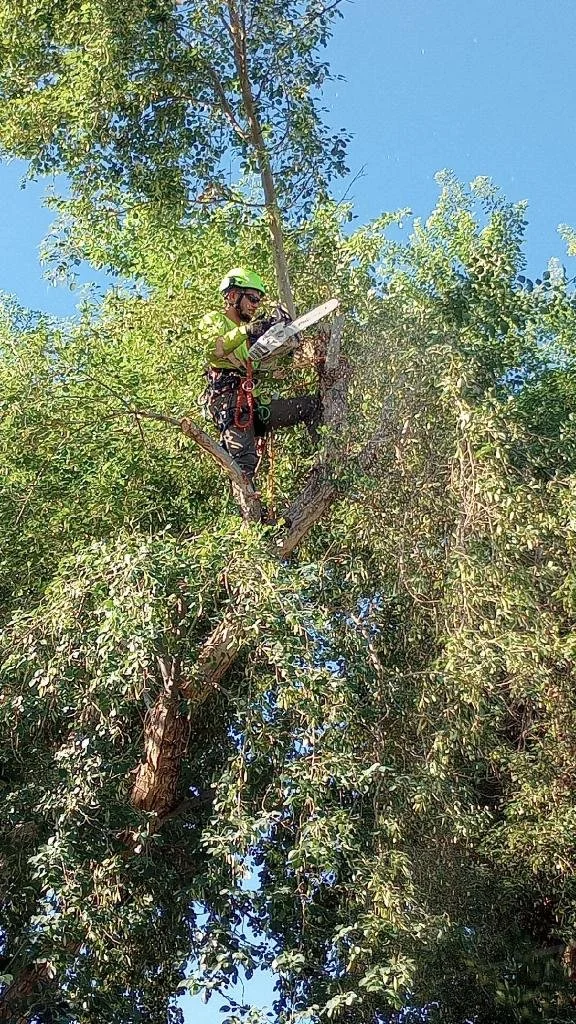
Certified Tree Climber, 2023.